A Noughts and Crosses Robot: From 3 × 3 to 4 × 4
Introduction
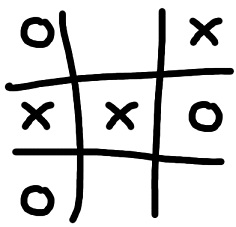
Noughts and crosses (tic-tac-toe) is a classic game in which two players take turns placing their pieces on a 3 × 3 board. The first player to form a horizontal, vertical or diagonal line of three matching pieces wins. On the standard nine-square board, neither player can guarantee a win against an opponent who plays perfectly. To explore a larger playing space, I extended the game to a 4 × 4 board in a later version.
|
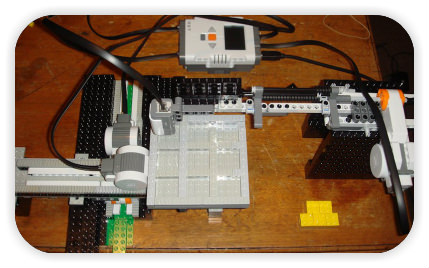
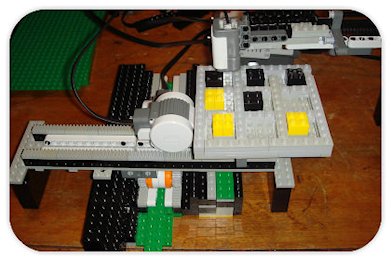
In early 2007, during my first year as an undergraduate, I designed my first noughts and crosses robot. Two motors moved the mechanism along the X and Y axes of the 3 × 3 board, while a third motor released a piece onto the board. I used a worm gear and a moving shaft to convert the LEGO motor's rotary motion into the linear motion needed to push the pieces into place. An inexpensive light sensor detected the colour of each piece. |
The robot won first prize in the University of London's 2009 Cool Computing Competition. Watch the original robot in action.
A Lightweight Noughts and Crosses Robot
I redesigned the robot in the summer of 2010, using a stationary game board and replacing the worm gear system with a continuous conveyor belt. Two colour sensors replaced the original light sensor to detect pieces more quickly. The entire robot fits on a standard 30 cm × 30 cm LEGO baseplate.
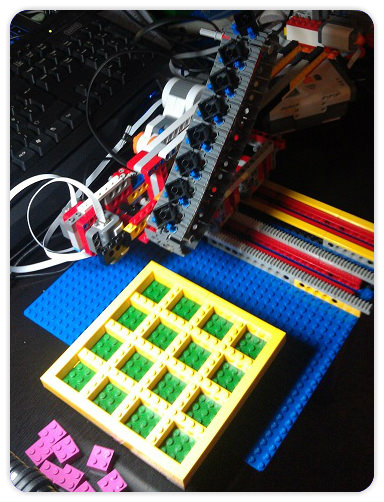
Watch the redesigned robot in action in the video below.